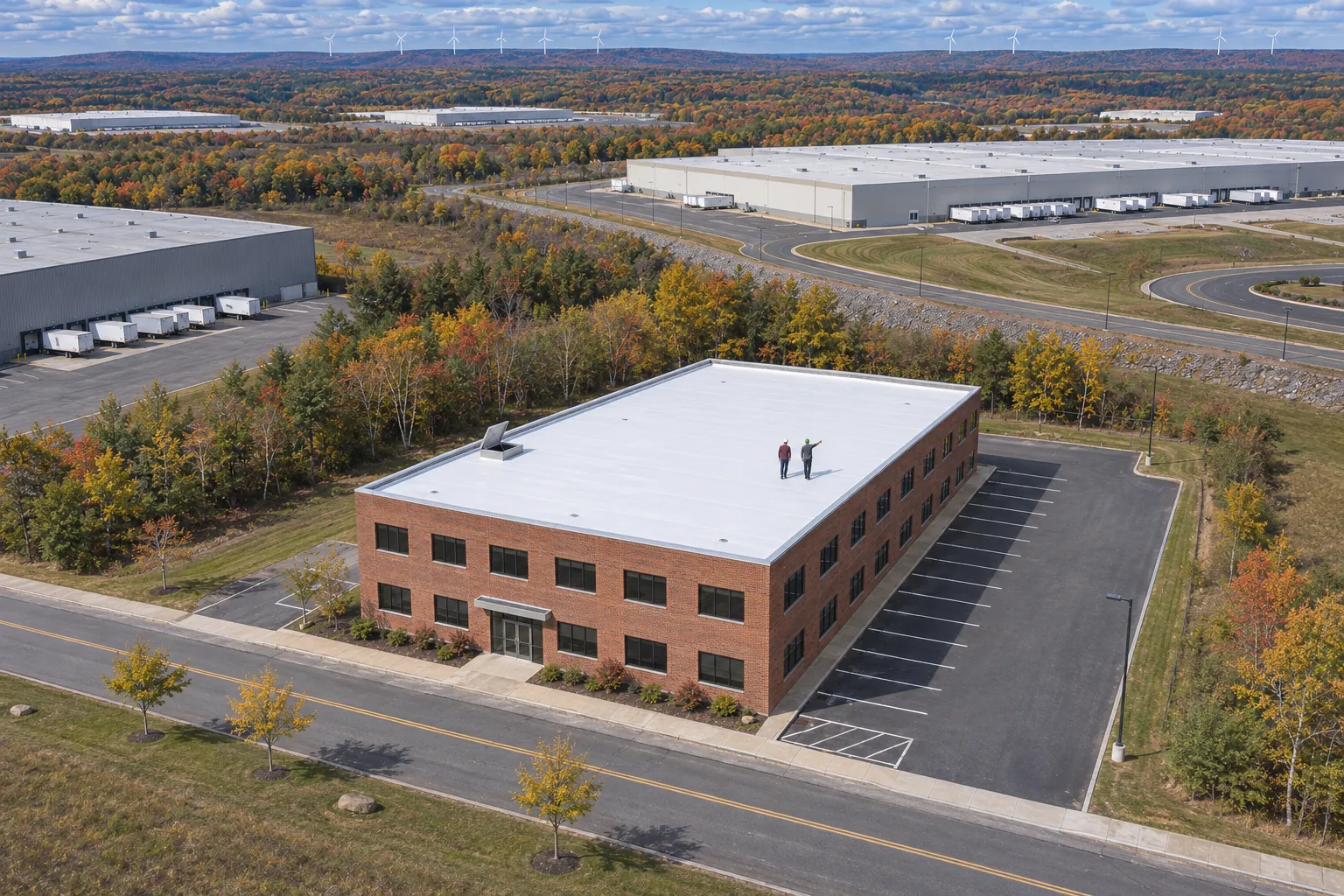
Brick commercial building with a new white flat roof in an industrial park among wooded ridges
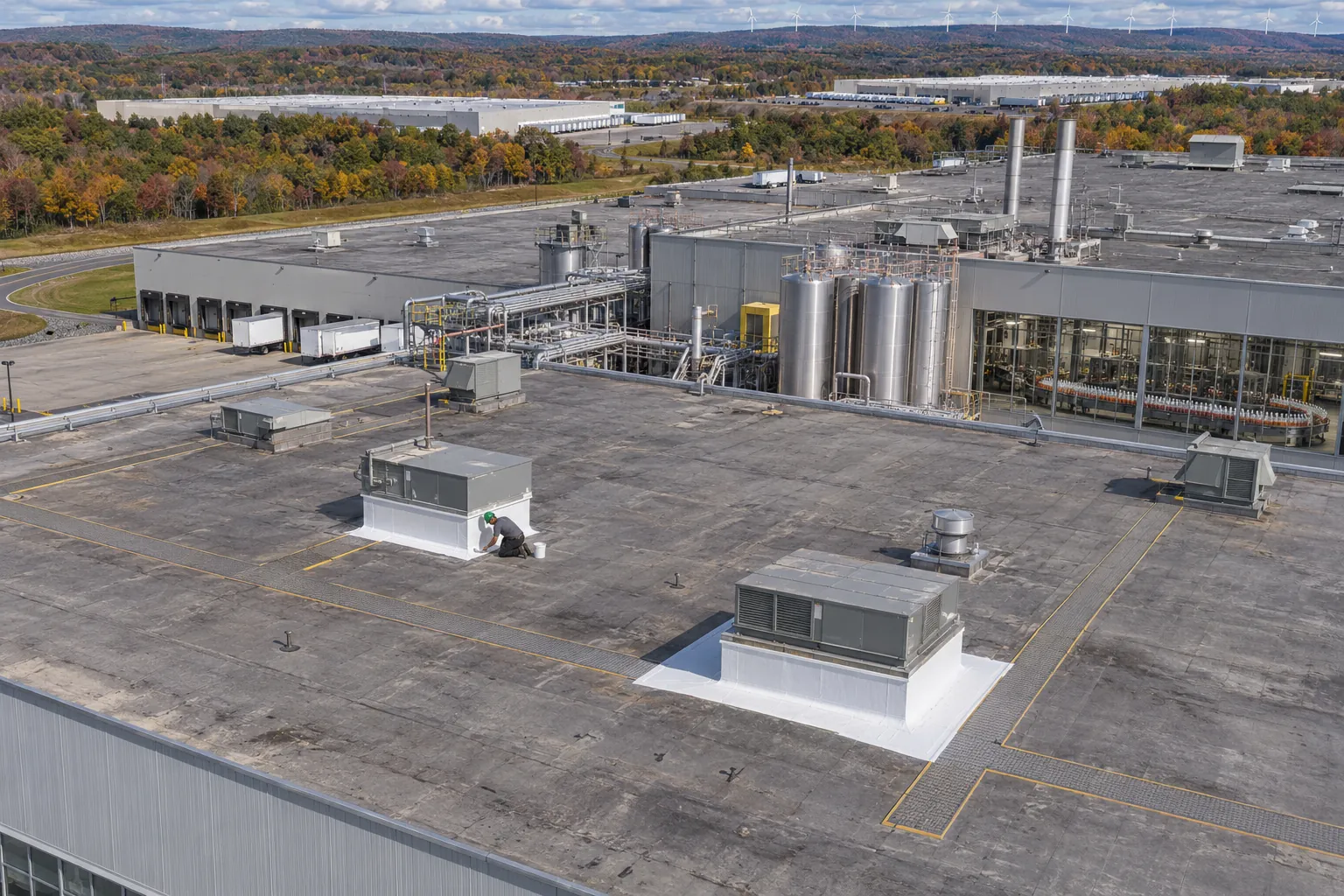
Bottling plant flat roof with rooftop units on new white curb flashing, exhaust stacks, and walkway pads
FAQ

Hazleton Commercial Roofing FAQ

Thirty Answers on Cost, Systems, Weather, and Nearby Buildings

This Hazleton commercial roofing FAQ answers thirty questions owners ask about pricing, roof systems, plant roofs, weather, codes, and nearby towns.

Using the Hazleton Commercial Roofing FAQ

The Hazleton commercial roofing FAQ is grouped by topic below. Jump to the part that matches your building, or read straight through.

Choosing a Commercial Roof in Hazleton

Pricing, the work under the old membrane, and which system fits come down to the building itself.

Why isn't a square-foot rate enough to price a Hazleton commercial roof?

A square-foot rate misses the roof's construction and the work needed beneath its surface. Our roof inspection sets the price for a specific building after we assess size, system and thickness, insulation, tear-off layers, deck repairs, edge metal, flashing, equipment, access, staging and season. Two equally sized roofs can therefore require substantially different scopes.

Does replacement cost include work beneath the old membrane?

Replacement cost should identify the planned work beneath the old membrane and explain how concealed damage will be handled. We establish a building's price through a roof inspection covering area, system thickness, insulation, removal layers, deck condition, edge metal, flashing, rooftop equipment, access, staging and season. Uncertain deck repairs should be discussed before removal starts.

Which suits a distribution center better, TPO or EPDM?

TPO or EPDM can suit a distribution center when the assembly matches drainage, attachment and operational needs. We compare welded TPO seams with the specified EPDM seam system, then examine insulation, traffic and rooftop equipment.

The decision should include how maintenance crews reach service points, rather than relying on membrane color or a single material preference.

Can maintenance records tell us how much life a commercial roof has left?

Maintenance records help explain a commercial roof's condition, but they cannot establish remaining life without an inspection. We compare past leaks and repairs with current seams, flashing, insulation and deck findings.

A roof with manageable surface wear presents a different outlook from one with hidden wet areas, even if both were installed around the same time.

Hazleton TPO Roofing Questions

Welded seams, equipment traffic, and crowded penetrations shape how a TPO roof performs on a plant or warehouse.

Is planning on thirty years of TPO service sensible for a bottling plant?

A bottling plant should not base its roof plan on a promised thirty years of TPO service. Installation quality, thickness, attachment, exhaust exposure and maintenance all influence performance.

We build the discussion around the proposed assembly and inspection findings, with particular attention to equipment access and detailing around plant vents rather than a fixed retirement date.

What TPO drawbacks matter on a roof with constant equipment traffic?

Puncture exposure and repeated work around flashing are practical TPO concerns on a roof with constant equipment traffic. We plan protected routes to service points and check whether equipment supports create awkward transitions.

The membrane still needs careful seam installation and compatible repairs; specifying TPO does not remove the risk of damage from tools or misplaced parts.

How does TPO differ from EPDM at crowded roof penetrations?

TPO and EPDM use different seam and flashing methods around crowded penetrations, which affects the details our crew can install and maintain. We examine spacing between pipes and curbs before choosing the assembly.

Where equipment leaves too little working room, rearranging access or redesigning the flashing can matter more than choosing one membrane over the other.

Can TPO seam welds be judged by their appearance alone?

Seam welds on TPO need checks beyond appearance because a neat edge does not establish a sound bond through the intended seam area.

We use the system's installation and inspection procedures, including attention to surface cleanliness and welding conditions. Difficult curb corners and starts or stops deserve the same scrutiny as long, straight runs across the roof.

Rubber Roofing and EPDM Questions

What an EPDM roof includes, why edges pull at parapets, and what a tear-off can uncover.

What does rubber roofing include besides the EPDM sheet?

An EPDM roof includes more than its rubber sheet: the assembly also needs suitable insulation, attachment, seams, perimeter details and penetration flashing. We review those parts together for a Hazleton commercial property. Choosing a membrane without resolving drainage or the supporting deck leaves important causes of roof trouble outside the material decision.

Why can EPDM pull away from a commercial parapet?

EPDM can pull away from a parapet when attachment, movement or the flashing detail is not performing properly. We inspect the membrane transition, terminations and surrounding substrate to identify the cause. Simply fastening the loose edge again can leave tension in the roof, so the repair or replacement detail must suit the actual condition.

Is ballasted EPDM practical where plant staff frequently cross the roof?

Ballasted EPDM needs careful consideration where plant staff frequently cross the roof because stone, access routes and hidden membrane condition affect maintenance. We also assess structural capacity and the assembly's suitability before comparing it with fully adhered EPDM. The owner's maintenance pattern belongs in that decision, alongside drainage, attachment and access to equipment bases.

When does an EPDM tear-off reveal a larger replacement scope?

An EPDM tear-off can reveal a larger scope when insulation, deck or underlying roof layers are damaged beyond the areas identified before removal. We use preliminary investigation to reduce that uncertainty and agree how concealed findings will be documented. Replacement planning should leave room to repair the supporting assembly rather than cover newly exposed problems.

Your Question Not Here?

Call and ask about your own roof. We answer roofing questions by phone and set up inspections when one is needed.

(570) 816-4034Call Us

Industrial Roofing Questions From Plant Owners

Material choice, curbs, daily closure, and what we learn inside the plant before work starts.

How are roof materials selected for an industrial park distribution building?

Roof materials for an industrial park distribution building should match its deck, drainage, attachment needs and daily operations. We review equipment loads and maintenance routes before discussing membrane or metal options.

Large clear roof areas and tightly packed service zones can need different details even within one building, so material selection follows the full roof layout.

Should equipment curbs be changed during a bottling plant reroof?

Equipment curbs can need changes during a bottling plant reroof if the new assembly affects flashing heights, drainage or service access. We measure the existing conditions and coordinate any equipment work before installation.

Keeping an unsuitable curb simply because it is already there can leave a new roof with the same difficult transition as the old one.

How can a bottling plant plan daily roof closure during industrial replacement?

A bottling plant needs roof replacement sections sized and sequenced so each opened area receives appropriate protection before work stops. We coordinate that daily closure with production, intakes and interior protection.

Weather and concealed roof findings can change the sequence, so the plan must provide workable stopping points rather than depend solely on the end of a production shift.

What information should an industrial roofing contractor gather inside the plant?

An industrial roofing contractor should gather leak locations, equipment restrictions and production concerns from inside the plant. We compare that information with the roof plan and ask where water would cause the greatest disruption. Interior evidence often helps direct roof investigation, while operating restrictions shape access, debris control and the order of replacement work.

Commercial Metal Roofing Questions

Exhaust openings, panel types, humid work areas, and installing metal over an existing roof.

Why do commercial metal roofs develop trouble around added exhaust openings?

Added exhaust openings can create trouble when their flashing or supports do not accommodate the metal roof's movement. We examine panel cuts, curb attachment and the drainage path around each opening. Equipment should have a suitable connection to the roof assembly; relying on surface sealant around an improvised penetration leaves a difficult detail to maintain.

Which maintenance differences separate standing seam and exposed-fastener roofs?

Exposed-fastener roofs require attention to accessible screw and washer conditions, while standing seam roofs have their own seams, clips and flashing details to inspect. We compare those maintenance needs with the building's access and use. Neither panel style eliminates upkeep, and penetrations or perimeter details can govern performance regardless of the main panel connection.

Can an agricultural business use metal roofing above a humid work area?

An agricultural business can use metal roofing above a humid work area when the assembly addresses indoor moisture and condensation.

We review insulation, ventilation and air movement rather than treating the panels alone as the solution. Fastening and corrosion exposure also need attention, particularly where cleaning, stored materials or daily operations create a demanding interior environment.

What could prevent installing metal above an existing commercial roof?

Wet existing materials, unsuitable support or unresolved drainage can prevent installing metal above a commercial roof. We investigate the old assembly and how the new panels would be attached before recommending a recover approach.

Added height also affects curbs and edges, so retaining the old roof requires a complete construction plan rather than a simple cover-up.

Hazleton Weather, Damage, and Code Questions

Freeze-thaw cycles, snow and ice, hail, damp masonry, and the statewide code that applies to a reroof.

How do freeze-thaw cycles affect roof planning on a Hazleton commercial block?

Freeze-thaw cycles make drainage and moisture control especially relevant to roof planning on a commercial block. We examine water held near parapets, outlets and uneven roof areas before designing replacement details. A new covering should connect to sound flashing and a workable drainage route so recurring wet areas are addressed as part of the project.

Could heavy snow and iced gutters expose weaknesses in a new roof design?

Heavy snow and iced gutters can expose drainage or support concerns that deserve attention during roof design. We review existing distress, outlet locations and the proposed assembly before work begins.

Snowmelt must have a path off the roof, and any uncertainty about structural capacity calls for the appropriate evaluation rather than an assumption based on membrane condition.

Does summer hail damage always mean a whole commercial roof must be replaced?

Summer hail damage calls for an inspection before anyone decides a whole commercial roof needs replacement. We inspect the covering, seams, flashing and underlying materials to establish the extent of damage.

Insurance coverage depends on the policy and cause, while our roof recommendation depends on physical findings; those are separate decisions that should not be treated as interchangeable.

Could damp masonry beside the roof be an indoor humidity problem?

Damp masonry beside a commercial roof can involve indoor humidity, roof leakage or water entering through the wall. We inspect the roof-to-wall transition and compare moisture patterns with weather and building operation. In an older brick building, replacing the roof without identifying the moisture route can leave the owner with the same damp area afterward.

Which code framework applies when planning a Hazleton commercial reroof?

Pennsylvania's Uniform Construction Code is the statewide code framework relevant to commercial reroof planning. We provide the proposed assembly and scope to the reviewing authority to establish project-specific requirements. The existing layers, intended removal and any equipment changes should be clear before the owner relies on a permit assumption or schedules construction.

Questions From Nearby Towns

Owners in Bloomsburg, Pottsville, Berwick, Tamaqua, and Catasauqua asked about their own buildings.

Can a Bloomsburg distribution roof be replaced without blocking every dock?

A Bloomsburg distribution roof may be replaced while some docks remain available if staging and overhead work can be separated from deliveries. We map the dock schedule against roof access and material movement.

The plan needs clear exclusion areas and daily coordination so a change in roof activity does not unexpectedly place traffic under active work.

Should a Pottsville commercial block share one roof drainage plan?

Connected roofs on a Pottsville commercial block need coordinated drainage planning wherever water crosses between sections. We identify outlets, height changes and ownership boundaries before recommending work. Replacing one section can affect the adjoining roof's water route, so the design should account for those connections even when the contracts or maintenance responsibilities are separate.

How can a Berwick bottling plant prepare for rooftop equipment lifting?

A Berwick bottling plant can prepare for rooftop equipment lifting by coordinating shutdowns, lifting access and the roof work that must follow.

We identify curbs and flashing areas that will become exposed and plan how to protect them. Equipment crews and roofers need an agreed sequence so completed roofing is not damaged while the machinery is repositioned.

What belongs in the replacement plan for a Tamaqua shop with several roof levels?

A Tamaqua shop with several roof levels needs a replacement plan that addresses each transition and the water arriving from higher sections. We inspect walls, lower-roof outlets and access between levels before choosing the sequence. A small lower roof may need substantial detailing because it receives runoff and connects several different parts of the building.

Does a Catasauqua commercial roof need an inspection before a new tenant moves in?

A roof inspection before a new tenant moves into a Catasauqua commercial building can identify leaks and access needs before the space fills with equipment.

We document visible conditions and recommended work for the parties to review. Responsibility for that work depends on their lease terms, so the inspection should inform the discussion without substituting for checking the lease.

Ask What the Hazleton Commercial Roofing FAQ Missed

Every roof is different. Call or request an estimate and we will look at yours.

Call Us (570) 816-4034